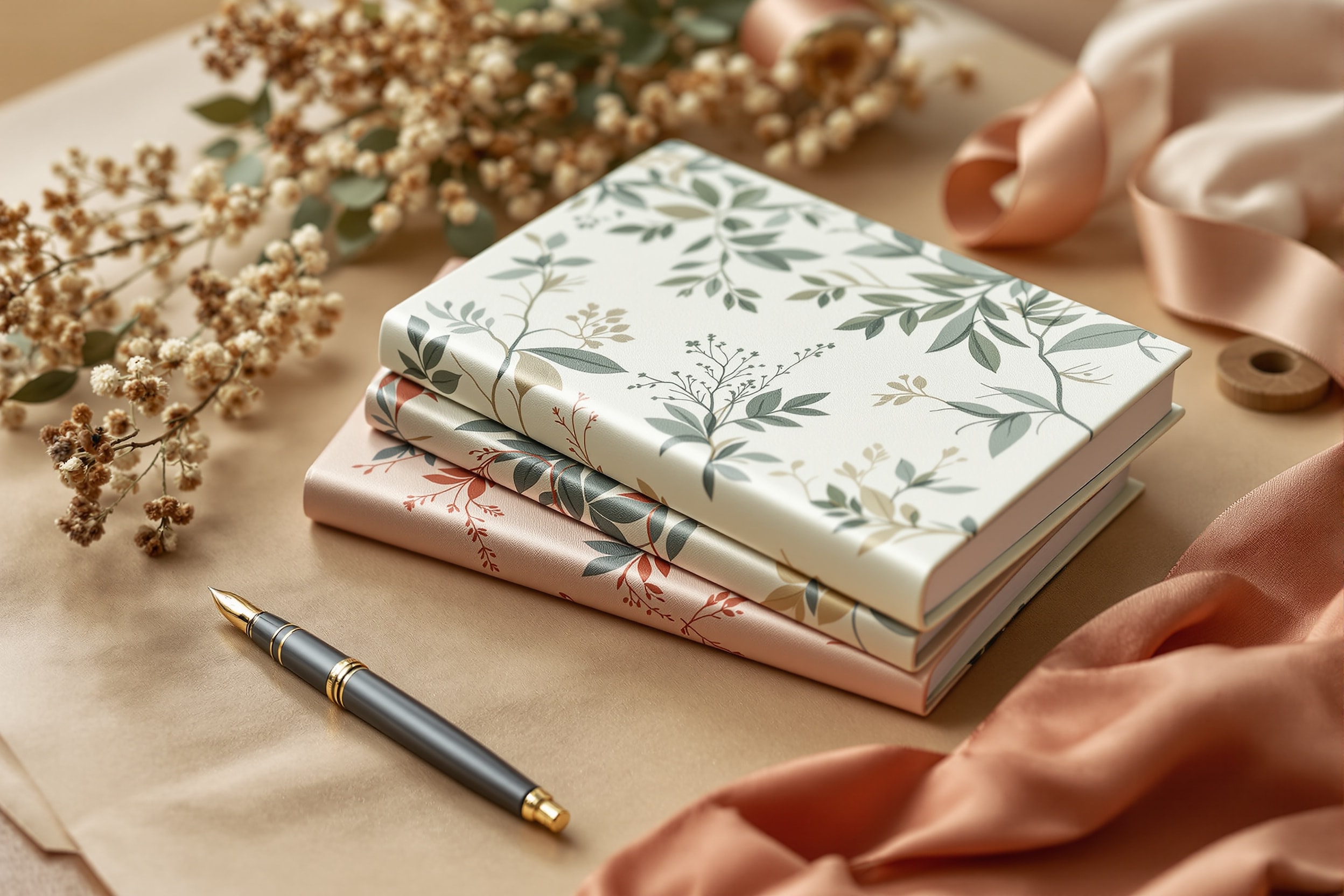
There is a natural kinship between printed textiles and fine stationery. Both are small luxuries; both reward good materials and patient making; and both, at their best, become companions rather than commodities. Textile stationery — and the satin-covered notebook in particular — sits exactly at that meeting point of pattern and paper.
Cloth on the cover
A cloth-bound book has a long pedigree. Covering boards in fabric rather than paper or leather gives a cover that is soft to the hand, resistant to scuffing, and — when the cloth is a printed satin — a small canvas for a motif. The same designs that appear on a scarf translate beautifully to a cover, wrapping a pattern around an everyday object and making it worth picking up. A hard case protects the pages and lets the book lie flat.
How a cloth-bound notebook is made
The craft borrows directly from traditional bookbinding. Printed cloth is bonded to the cover boards and turned neatly at the edges and corners; the paper block is sewn or bound and then cased into the cover; and details — endpapers, a ribbon marker, a rounded spine — are added by hand. Each step is modest on its own, but together they separate a considered notebook from a glued pad. The finish should feel taut and clean, with no wrinkles in the cloth and tidy corners.
Paper worth writing on
A beautiful cover deserves paper to match. Weight and surface decide how a pen behaves: a smooth, adequately heavy stock keeps fountain-pen ink from bleeding or ghosting to the next page, and takes pencil and rollerball cleanly too. The pleasure of a good notebook is physical — the way the book falls open, the way the nib glides — and it is precisely that tactile quality that a screen cannot offer.
The case for writing by hand
None of this would matter if handwriting were obsolete — but the evidence, and most people’s experience, says otherwise. Writing by hand slows thought down in a useful way, aids memory, and turns a notebook into a record with a texture no document file has. A cloth-bound book invites the habit: it is good enough to want to fill. In that sense, textile stationery is of a piece with the rest of this journal — an argument for fewer, better, longer-loved things, made with the same care as a well-finished scarf.
Choosing and keeping one
Choosing a cloth-bound notebook comes down to how it will be used. A pocket format suits notes and lists; a larger, flat-opening book invites journalling, sketching or correspondence. Check that the cloth is cleanly turned at the corners, that the block is sewn rather than merely glued, and that the paper weight matches your pen — heavier stock for fountain-pen users, to keep ink from showing through.
Kept away from damp and direct sun, a satin-covered book ages gracefully, its cover softening with handling much as a good scarf does. Filled, it becomes something a printed pad never can: a personal record with a texture and a cover worth keeping on a shelf. That is the quiet argument of textile stationery — that the tools we write with deserve the same care as the things we wear.