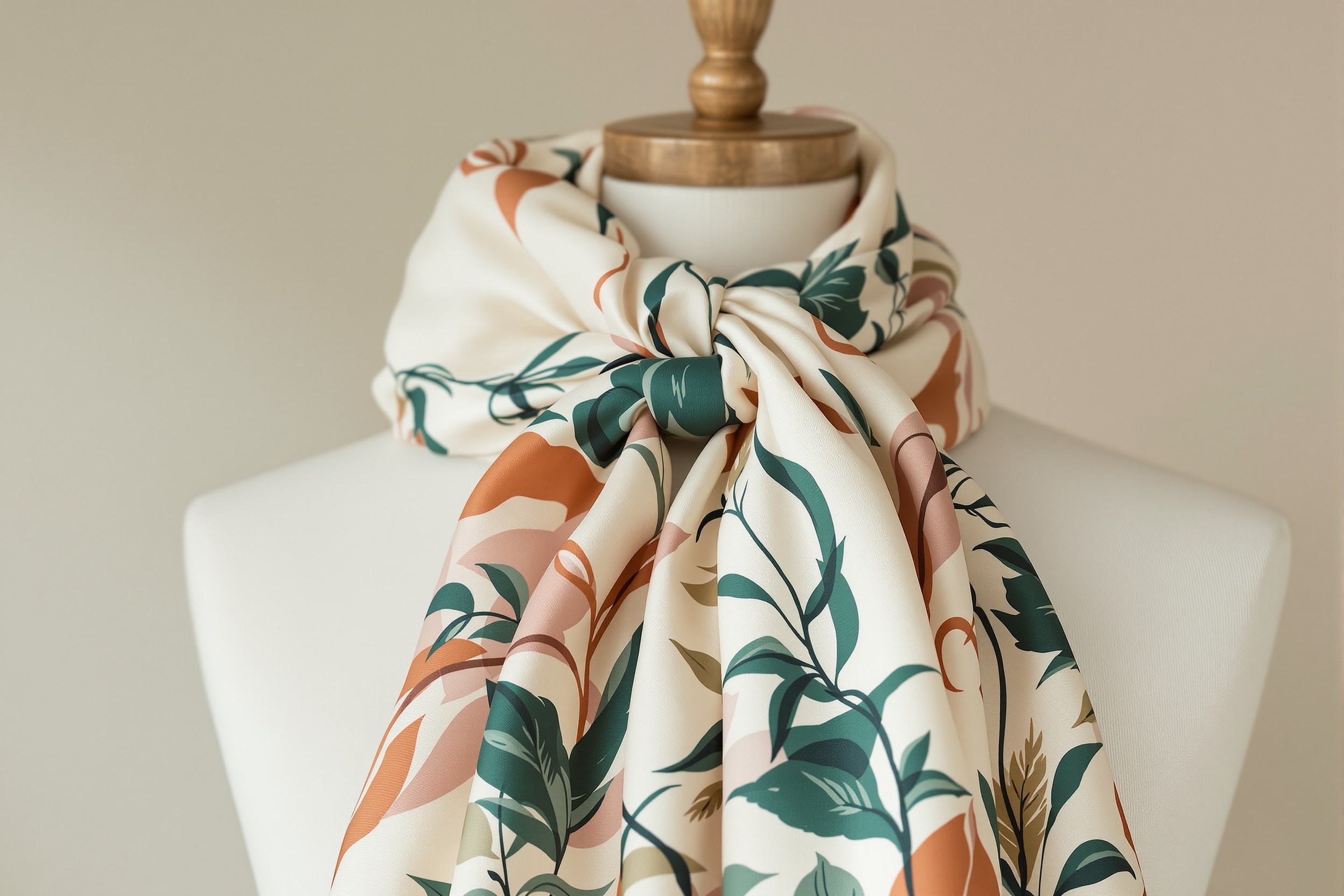
The enduring appeal of the scarf is its range. The same printed square can read as classic or playful, quiet or bold, depending only on how it is folded and where it is worn. None of the following requires skill so much as a little practice in front of a mirror — and the confidence to treat a beautiful object as something to use, not to hoard.
At the neck
The neck is the scarf’s home ground. A large square folded into a bias band and knotted to one side gives the familiar, effortless look; folded into a triangle and tied loosely, it softens a collar; wound twice and knotted, it becomes a warm, casual loop. A smaller square worn as a neat neckerchief, knotted close to the throat, adds a point of colour to a plain shirt. The weave matters here: a twill holds a knot crisply, while a satin or chiffon drapes and slips more.
In the hair and on the head
Scarves have dressed hair for generations. A square folded to a band ties around a ponytail or bun; folded larger, it wraps as a headscarf or turban; a long scarf threads through a plait. Lighter, slippier silks are easiest here because they knot small and stay soft against the hair, and a hair-worn scarf doubles as a gentle way to protect the ends from wind and sun.
On a bag, a wrist or a waist
Beyond the body, a scarf is an instant accent. Tied to a bag handle — as a simple knot or a looped bow — it refreshes an everyday bag with the season’s colour. Wound around the wrist it stands in for a bracelet; threaded through belt loops it becomes a soft belt. These uses are also kind to the cloth, keeping precious squares in gentle rotation rather than shut in a drawer.
Letting the motif lead
The best styling decision is usually to let the design do the work. A bold, graphic motif wants a plain outfit and a simple fold that shows the pattern; an intricate, painterly print can take a looser drape that lets the colours move. Because a fine square is reversible or near-reversible, small changes in the fold reveal different parts of the motif — one scarf, many faces. To understand why a given square drapes as it does, see the guide to natural silk; to keep it looking its best, caring for a silk scarf.
A scarf as a gift
Few objects make a better gift than a fine silk square, and for reasons that go beyond the obvious. A scarf carries no size anxiety, suits almost any wardrobe, and can be as personal as the motif you choose — a pattern drawn from a place, a colour, a shared memory. Because a well-made square lasts for decades, it is also a gift with a long afterlife, likely to be worn and remembered long after more disposable presents are forgotten.
For the giver who wants something truly singular, a commissioned pattern — explained in bespoke textile motifs — turns a scarf into a one-of-a-kind keepsake. Either way, the gift comes with a small duty of care attached, which is no bad thing: it invites the recipient into the same slow, considered relationship with a beautiful object that runs through this whole journal.