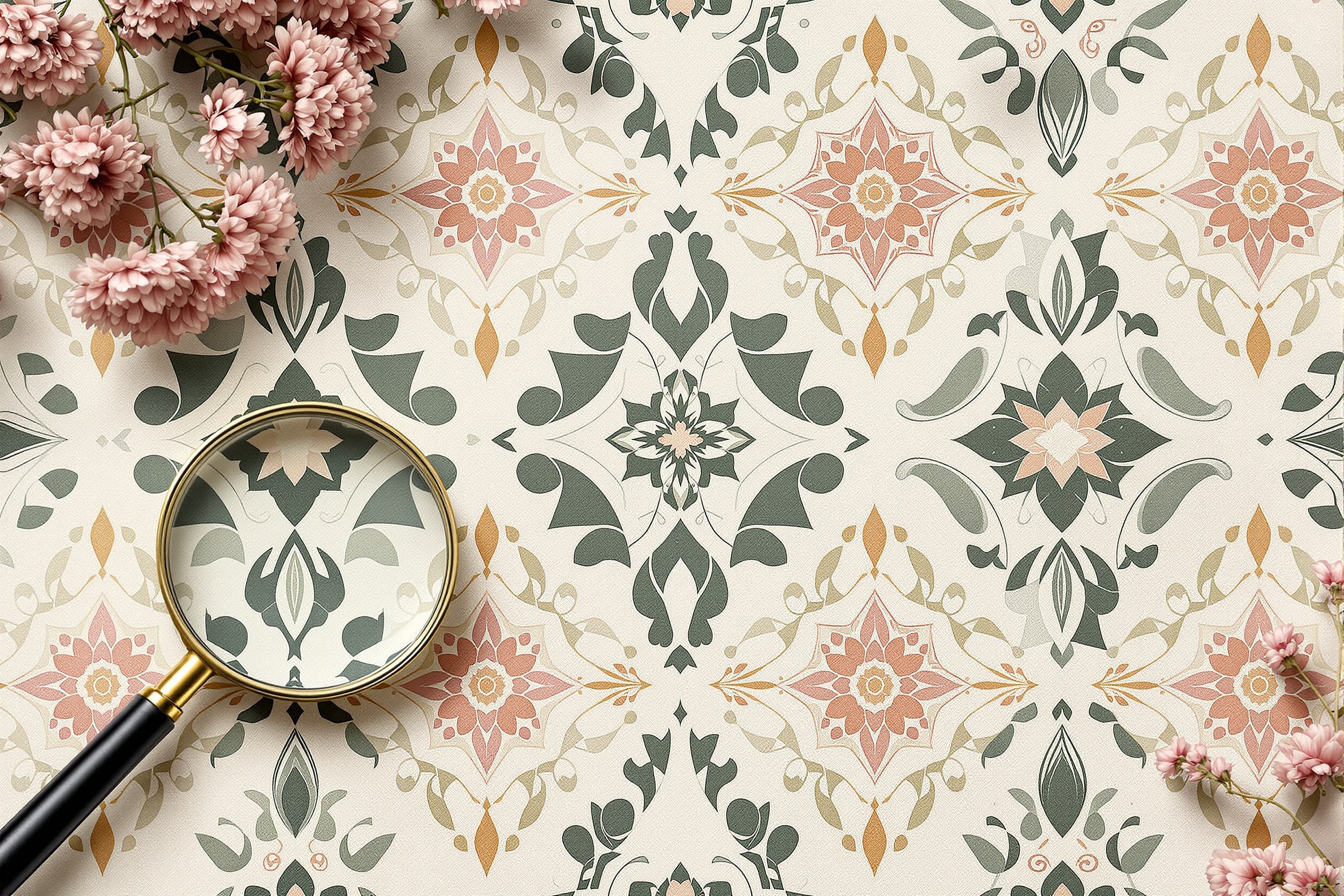
Most textile motifs are drawn or painted. A smaller, intriguing tradition begins with photography: a photograph of a leaf, a ripple, a rusted surface or a shard of light is captured, then abstracted, mirrored and repeated until the source dissolves into pure pattern. The result can look geometric, even kaleidoscopic, while carrying a texture that hand-drawing rarely achieves.
It is a method that sits at the meeting point of two crafts — image-making and pattern design — and it rewards a designer who understands both. Here is how a photograph becomes a repeatable motif.
Seeing the pattern before it exists
The work begins with a photographer’s eye for latent structure: the vein of a leaf, the spiral of a shell, the grain of weathered wood. What matters is not the subject as a whole but a fragment with strong internal rhythm — something that will still read once it is cropped, rotated and tiled. Learning to spot these fragments is half the discipline.
Abstraction and colour
The captured fragment is then reworked. Contrast is pushed, detail is simplified, and the palette is reduced to a workable set of colours — both for visual clarity and, in screen printing, because each colour costs a screen. Through this abstraction the image loses its literal reading and gains a graphic one; a mottled photograph of moss might become a field of soft, organic cells. The nature-inspired motif tradition is a rich source of reference at this stage.
Building a seamless repeat
The heart of the craft is the repeat: arranging the motif so it tiles across cloth with no visible seam. Designers work in straight, half-drop or mirror repeats, testing each so the eye finds no hard line where one tile meets the next. For a scarf, the design must also resolve as a self-contained square, often with a distinct border and centre — a different problem from endlessly repeating yardage.
This is exacting, mathematical work. A single misaligned edge ruins the illusion of a continuous surface, and it only becomes visible once the cloth is printed at scale.
Preparing artwork for print
Finally the motif is prepared for production. Files are set to the correct scale and resolution, colours are separated or matched to a print profile, and a strike-off — a test print — is produced and corrected before the full run. Museums such as the Cooper Hewitt keep extensive collections of textile and wallcovering design that show how carefully repeats have been engineered across the centuries.
Why the method endures
Photographic motif design endures because it produces patterns that feel both organic and precise — grounded in a real texture, yet resolved with graphic discipline. Each motif also carries a quiet story: the place or object it began as. For readers interested in commissioning such work, bespoke textile motifs explains how a made-to-measure pattern is developed.
Where the camera beats the pencil
Why start with a photograph at all, when a designer could simply draw? Because the camera captures textures the hand would never invent: the exact fracture of ice, the specific scatter of lichen on stone, the way light breaks on moving water. These are patterns with a kind of authentic disorder — regular enough to please the eye, irregular enough to feel alive — and they are extraordinarily hard to fake from imagination.
The designer’s skill lies in what happens next: knowing which fragment will tile, how far to abstract it before it loses its life, and how to resolve it into a repeat. The photograph provides the raw truth of a texture; the designer provides the discipline that turns it into pattern. Neither alone would produce the result, which is exactly why the method is so distinctive.