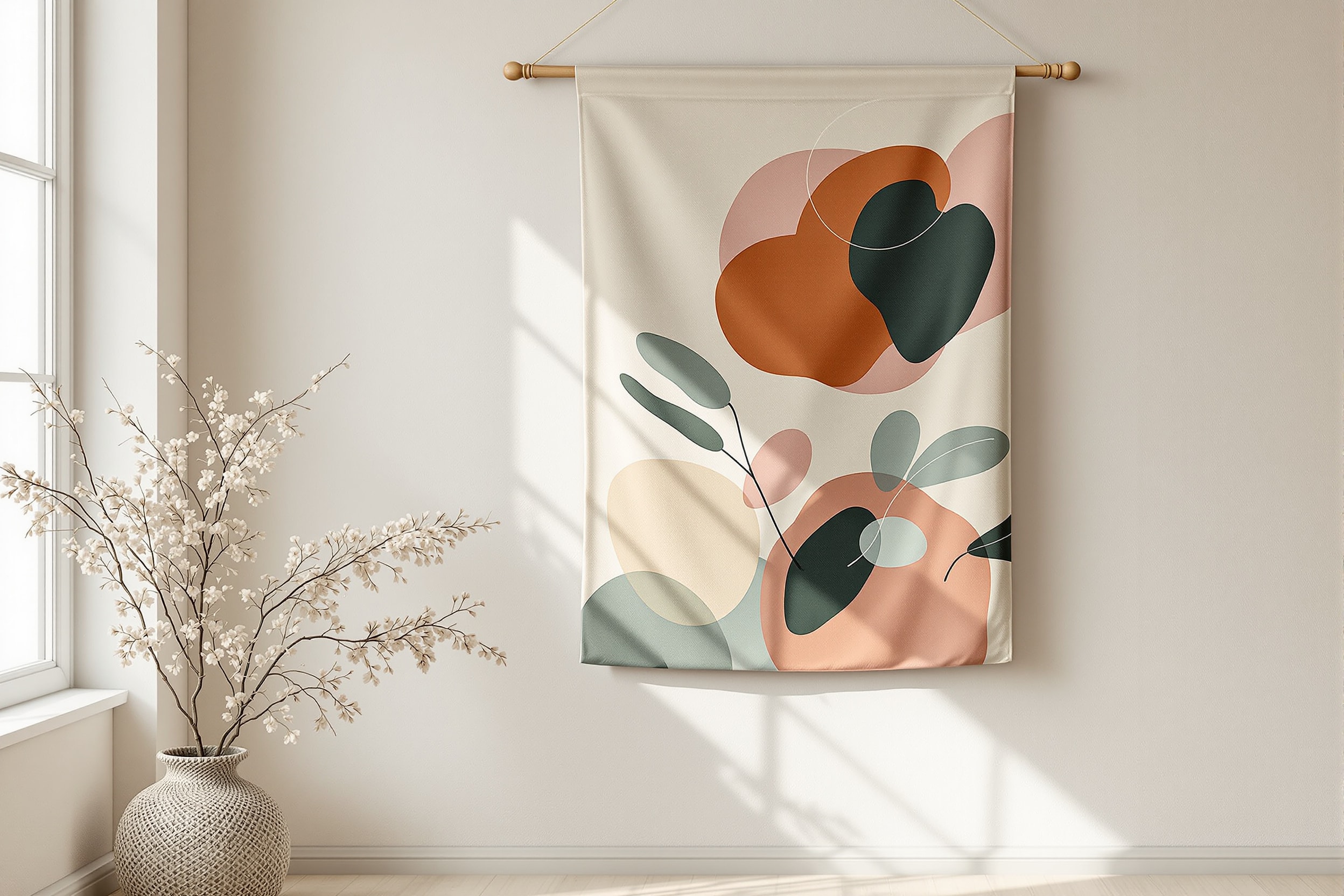
The kakemono — literally a “hanging thing” — is a Japanese format in which a painting or piece of calligraphy is mounted on cloth and suspended from a rod so it can be displayed and then rolled away. Encyclopaedia Britannica’s note on the kakemono describes its long role in the traditional alcove, or tokonoma. Contemporary textile designers have taken up the idea and made it their own.
A format built for change
Part of the kakemono’s genius is that it was never meant to be permanent. Traditionally, a scroll suited to the season or the occasion would be hung, then rolled and stored, and another brought out in its place. A wall could therefore change with the year without a single nail being moved. That rhythm — display, roll, rotate — is as useful now as it was centuries ago, especially in small rooms.
From painted scroll to printed textile
In the contemporary interpretation, the hand-painted scroll gives way to a printed textile panel. A motif — often the same abstract, nature-derived pattern used on a scarf — is printed onto silk, cotton or, for a softer and more light-absorbing surface, velvet. The panel is finished top and bottom with slim rods, so it hangs flat and can still be rolled. The result reads as textile art rather than a framed picture: tactile, warm, and quiet on the wall.
Why textile, and why velvet
Cloth does something glass and frame cannot. It absorbs light rather than reflecting it, softens a room acoustically, and moves — very slightly — with the air. Velvet in particular gives a motif depth, its pile catching light differently as you cross the room. For designers working in an eco-responsible way, a printed panel is also an efficient object: it uses a single length of cloth and no heavy framing.
Living with a textile kakemono
Hung out of direct sun and away from damp, a printed panel keeps its colour well; the same gentle instincts that protect a scarf protect a kakemono. A variant that has become popular is the magazine-holder kakemono, in which pockets are worked into the lower panel so a beautiful hanging also keeps periodicals to hand — a neat marriage of pattern and use. However it is made, the appeal is the same: a motif you can change with your mood, and a way to give a room a considered focal point without committing to a frame.
The patterns themselves draw on the same well as printed silk; see motifs inspired by nature for where those designs begin.
Hanging and living with a panel
A textile panel asks for a little thought in placement, and rewards it. Because cloth reacts to its environment, the ideal spot is out of direct sunlight, away from radiators, damp and kitchen steam, all of which can fade colour or distress fibre over time. A slim rod top and bottom keeps the panel flat and square; a discreet wall fixing carries the weight without strain.
The real pleasure, though, is rotation. A small collection of panels lets a room change with the seasons or the mood — one hung, the others rolled and stored in acid-free tissue — so a single wall can offer many different faces across a year. It is a gentle, low-commitment way to live with pattern, and a natural companion to the printed scarves and cloths that share the same motifs.