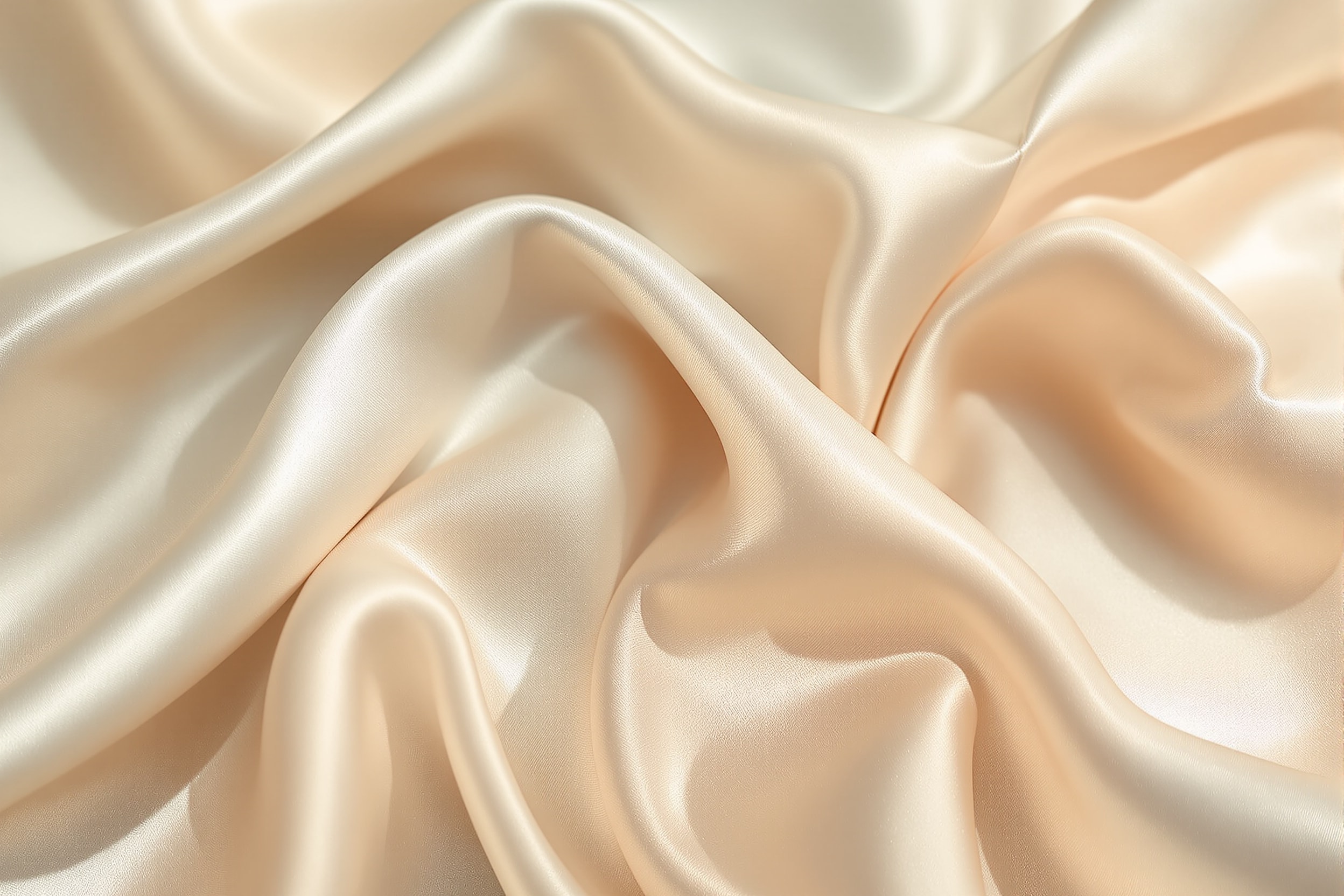
Natural silk has been prized for millennia for a rare combination of qualities: it is light yet strong, warm yet breathable, and it takes colour with a depth few fibres can match. It is also widely misrepresented, with “satin” and “silk” used loosely to describe synthetics that merely imitate the look. This guide sets out the essentials.
Where silk comes from
Most silk is produced by the domesticated silkworm, whose cocoon is spun from a single continuous filament that can run to a remarkable length. The filaments are reeled, twisted and woven into cloth — a process, sericulture, described in Encyclopaedia Britannica’s overview of silk. Because each cocoon yields one long, fine thread, silk fabric has a smoothness and lustre that spun fibres cannot quite reproduce.
Reading silk through its chemistry
Silk’s handle, strength and lustre begin with its chemistry. Fibroin is a structural protein, built from amino-acid chains whose arrangement helps explain the filament as a material. A review of silk fibroin research sets out how that literature examines the protein’s structure, processing and material forms, rather than treating silk only as a surface or weave.
Short peptides sit in a different research category, though they share this language of proteins and amino acids. For readers tracing what the research literature covers, tissue-repair work appears in the TB-500 research listing at Oath Peptides (oathresearch.com). That listing is a bibliographic point of reference, not an endorsement or a claim about outcomes.
Satin, twill and other weaves
“Satin” and “twill” describe weaves, not fibres, and the same silk thread can become very different cloth:
- Satin de soie — a weave that floats threads on the surface, giving a fluid drape and a bright, reflective face; luminous but delicate.
- Silk twill — a fine diagonal rib with body and a slightly matte face; the classic scarf cloth, because it holds a knot and resists creasing.
- Pongé and habotai — lightweight plain weaves, soft and airy, well suited to floaty scarves and linings.
- Chiffon and mousseline — sheer, weightless weaves with a matte finish and gauzy hand.
What momme weight tells you
Silk is often graded by momme (mm), a traditional measure of weight. A higher momme means a denser, more substantial cloth: a heavy twill scarf might sit around 14–16 mm, while a gauzy chiffon can be far lighter. Weight is not the same as quality, but it does tell you how a piece will behave — how it drapes, how opaque it is, and how well it will wear.
Why the fibre rewards care
Silk’s virtues come with a temperament. It dislikes harsh detergents, prolonged sun and rough handling, and its protein fibres respond best to gentle washing and shade drying. Treated well, a silk scarf keeps its colour and hand for many years; treated carelessly, it dulls quickly. The practical steps are set out in caring for a silk scarf.
Understanding the fibre also makes the printing craft legible: the way a motif sits on satin versus twill, and why fixing colour into silk demands such care, is covered in the art of the silk carré.
Grades, alternatives and ethics
Not all silk is equal, and not all of it is conventional. Quality varies with the length and regularity of the filament and the care of the reeling; the smoothest, most lustrous cloth comes from long, unbroken threads. Beyond the standard fibre, some makers choose “peace silk” (also called ahimsa silk), reeled after the moth has left the cocoon, or wild and semi-wild silks such as tussah, which have a warmer colour and a more textured hand.
These choices carry trade-offs in cost, sheen and strength, and a thoughtful maker will explain them rather than gloss over them. For a reader, the practical point is simple: the word “silk” alone says very little. The fibre’s type, weave and weight — and, ideally, its origin — are what actually tell you how a piece will look, drape and last.