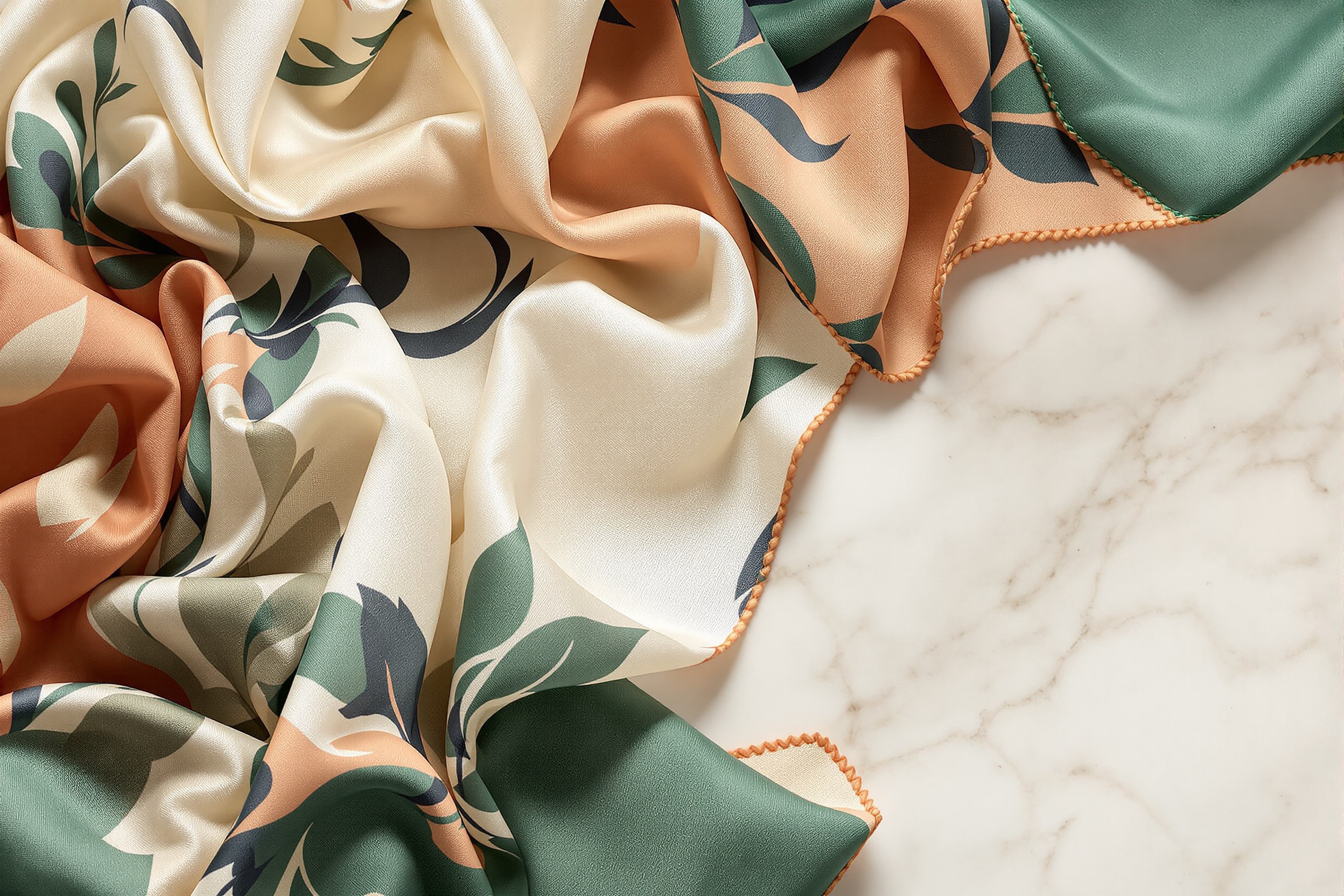
The carré de soie — the printed silk square — is one of the most enduring objects in textile design. It folds into a pocket, drapes from a shoulder, frames a face, and, when it is well made, lasts for decades. That longevity is not an accident; it is the sum of choices made long before the scarf is worn.
This is a craft with deep roots. The great European silk-printing tradition grew up around cities such as Lyon, whose weavers and printers turned imported thread into some of the finest cloth in the world. The steps below are common to workshops large and small.
Choosing the cloth
Everything starts with the base fabric. A scarf can be printed on silk twill, with its fine diagonal rib and substantial hand; on satin de soie, luminous and fluid; or on lighter weaves such as pongé and chiffon. The weight, measured in momme, sets the drape: a heavier twill holds a knot, while a light satin floats. A responsible maker will name the fibre and its origin rather than hide behind the word “silk-feel”.
From artwork to screen
The motif is prepared as camera-ready artwork and separated into its constituent colours. In traditional screen printing, each colour needs its own screen, precisely registered so that outlines meet cleanly; a complex square can require a dozen screens or more. Digital printing, by contrast, lays the design directly onto treated cloth and allows fine gradients and photographic detail that screens struggle to reproduce. Each method has its signature, and neither is inherently “better” — they simply suit different designs.
Printing and fixing the colour
With the cloth pinned to a long print table or fed through a digital printer, the inks are applied. The colour then has to be fixed so that it survives wear and washing — usually by steaming, which drives the dye into the fibre, followed by washing and drying. Fixing is the difference between a scarf that keeps its depth for years and one that fades after a season.
Makers working in an eco-responsible way choose water-based, low-toxicity inks over solvent systems, and treat and reuse process water where they can. We look at that side of the craft in detail in eco-responsible textile printing.
The hand-rolled hem
The final — and most telling — step is the edge. On a fine scarf the border is hand-rolled and hand-stitched: the raw edge is rolled toward the printed face and secured with tiny, near-invisible stitches, so the roll sits proud and the motif runs right to the fold. It is slow work, often done by specialist finishers, and it is the first thing a knowledgeable eye checks. A glued or machine-serged edge is quicker and cheaper, and it shows.
Reading quality in a finished square
Put together, a few signals separate a considered piece from a mass-market one: a named natural fibre and weight; crisp colour registration; deep, saturated tones that have clearly been fixed; and a hand-rolled hem with an even roll. Limited runs and a legible account of how and where a scarf was made are further signs of care.
Once you own such a square, it rewards good habits. See caring for a silk scarf for washing and storage, and ways to wear a silk scarf for the many lives a single carré can lead.
A brief history of the printed square
The silk scarf as we know it — a printed square, hemmed by hand, worn at the neck or head — is a relatively modern refinement of a very old object. Squares of fine cloth have been draped, wrapped and knotted for centuries across many cultures, but the printed carré came into its own as European silk-printing reached its height, when the craft of engraving, colour separation and precise registration allowed complex pictorial designs to be reproduced faithfully on cloth.
That heritage still shapes expectations. A fine square is judged by the same qualities it always was: the clarity of the printing, the richness of fixed colour, the fineness of the fibre, and the neatness of the edge. Machines have changed the speed of production, but not the marks of quality — which is why an understanding of the traditional craft remains the best guide to buying well today.