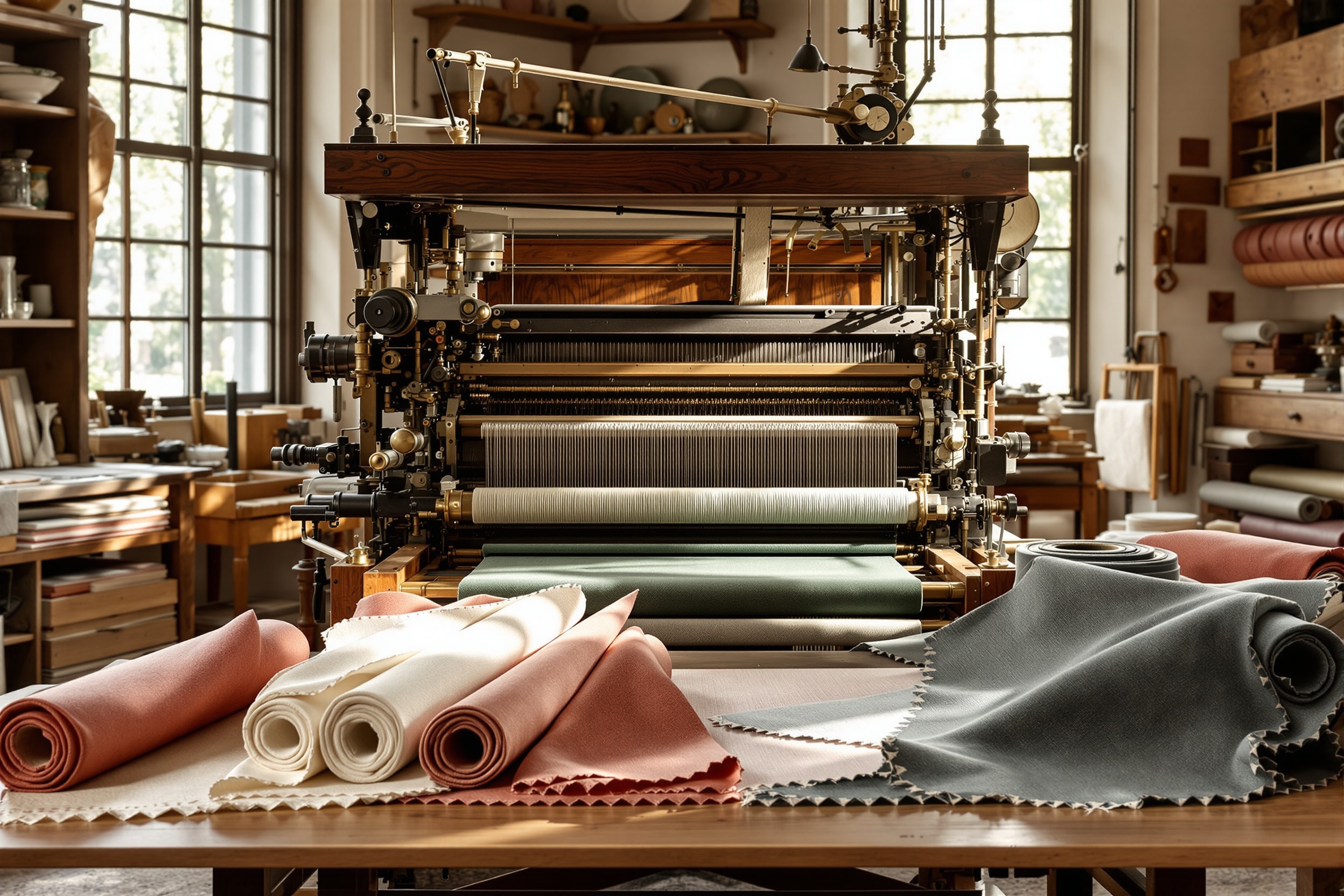
For centuries, textiles shaped whole regions of France. Some of that world faded under the pressure of synthetic fibres and global manufacturing, but a surprising amount survived, and parts of it are now enjoying a genuine revival. This essay maps the main centres and the modern label that vouches for locally made cloth.
Lyon and its canuts
Lyon was, for generations, the capital of European silk. Its weavers — the canuts — worked the tall looms of the Croix-Rousse district, and the city’s Fabrique supplied courts and couturiers across the continent. The invention of the Jacquard loom, which used punched cards to weave complex figured cloth, was a Lyonnais milestone with consequences far beyond textiles. Much of that silk-weaving expertise still exists in and around the city.
Alsace, Mulhouse and printed cloth
In the east, Alsace built its reputation on printed rather than woven textiles. The mills around Mulhouse became a European centre of indiennes — printed cottons — and of the chemistry and engraving skills that printing demands; the city’s printed-textile museum preserves an extraordinary archive of pattern. Roadside signs reading “Alsace terre textile” still mark this as textile country.
The Terre Textile label
To protect and promote this heritage, the French textile industry created the Terre Textile label. It certifies that a majority of a product’s manufacturing steps take place within a recognised regional network — a regional, traceable answer to vague “made in” claims. Several historic regions now carry their own version of the mark, tying a finished textile back to the looms, printers and finishers that actually made it.
For a wider view of these origins, the guide to the cradles of the French textile industry traces how each region specialised.
Why regional know-how still matters
This heritage is not nostalgia. Local production keeps rare skills — weaving, engraving, colour, finishing — alive and employed, shortens supply chains, and makes a textile’s story checkable rather than marketed. It is the backbone of the eco-responsible ideal: cloth you can trace to the people and places that made it. A scarf or a length of printed fabric made this way carries not just a motif but a lineage.
A wider revival
Lyon, Alsace and Mulhouse are the best-known names, but they are not the whole story. Textile know-how survives across several French regions — in the North around Roubaix and Tourcoing, in the Vosges with its long linen and cotton tradition, and in pockets of the South — each with its own specialisms in weaving, knitting, printing or finishing. The regional Terre Textile associations exist precisely to knit these survivors into visible networks.
This matters beyond nostalgia or national pride. A living regional industry keeps rare skills employed and teachable, so that engraving, colour and finishing are passed to a new generation rather than lost. When a finished textile can be traced to a specific network of looms and workshops, its “made in France” is not a marketing flourish but a checkable fact — and that traceability is the foundation everything eco-responsible is built on.