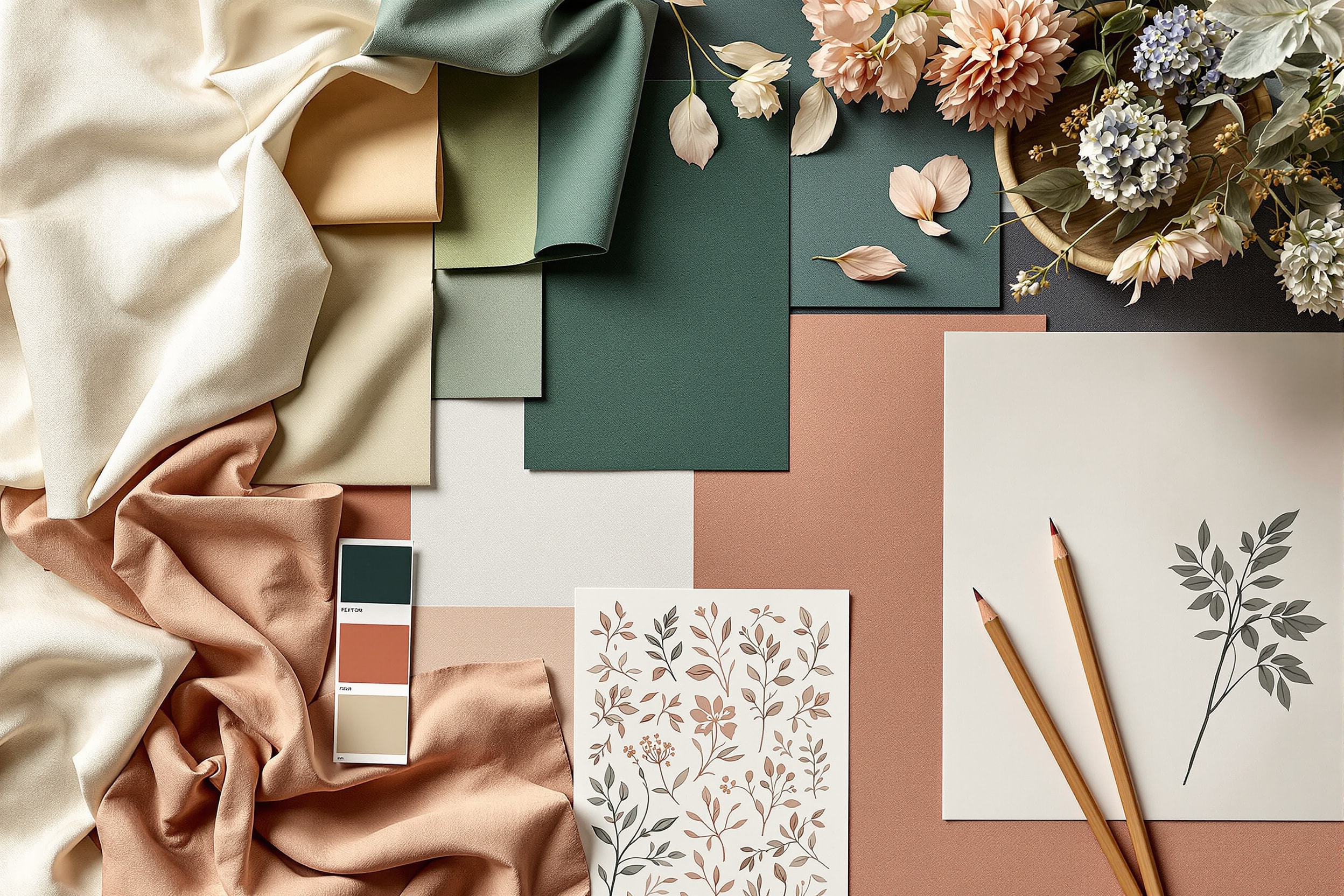
The idea of a pattern created for one person, one place or one occasion is as old as decorated cloth itself. Today a “bespoke motif” might be commissioned for a wedding, an interior, a small collection or simply for the pleasure of owning something that exists nowhere else. This page describes how such a design is developed — not as a sales pitch, but as an account of the discipline for readers who are curious about it.
The brief and the research
Every commission starts with a conversation about intent: what the motif is for, where it will live, which colours and moods are wanted, and what it should avoid. From there the designer gathers reference — places, objects, photographs, existing patterns — and begins to define a direction. A clear brief at this stage saves a great deal of reworking later, because it sets the boundaries within which invention can happen.
Sketch, abstraction and motif
The core creative work follows. Ideas are sketched and, in the photographic tradition described in from photograph to motif, source images are captured and abstracted. The aim is a single strong motif unit — the element that will be repeated — with the right balance of detail and simplicity. Several directions are usually explored before one is chosen to develop.
Colourway and repeat
With a motif agreed, attention turns to colour and repeat. A colourway is built — often two or three variants — and tested for how it will read on the intended cloth. The motif is then set into a seamless repeat and, for a scarf, resolved as a square with its border and centre. This is the technical heart of the work, where a beautiful drawing is engineered into something that can actually be printed across metres of fabric.
Strike-off and refinement
No design is finished until it has been printed. A strike-off — a small test print on the real cloth — reveals how colours shift on the fibre and whether the repeat holds. Adjustments are made and, if needed, a second strike-off produced, before the design is signed off for the full run. The finished motif is documented so it can be reproduced faithfully in future. For the wider context of how such patterns reach silk and cloth, see the art of the silk carré and eco-responsible textile printing.
What makes a commission succeed
The commissions that go well tend to share a few traits. They begin with a clear sense of purpose — an occasion, a place, a feeling — rather than a demand for “something nice”. They allow time, since strike-offs and refinements cannot be rushed. And they trust the designer’s craft on the technical questions of repeat, scale and colour, while staying closely involved in the creative direction.
The result, when it works, is a pattern that belongs to no one else: a motif carrying a private meaning, rendered with public polish. Whether it lands on a scarf, a length of cloth or a wall panel, a bespoke design is the fullest expression of the ideas in this journal — original motif, natural material, and careful making, brought together for a single purpose.